SmokeNet - Proactive Air Quality Forecasting
Next-day PM2.5 forecasting for Melbourne, with chronological evaluation and methods for inspecting model predictions. Published at AJCAI 2025.
Lead researcher · First & corresponding author
Read the published paper Source code & documentation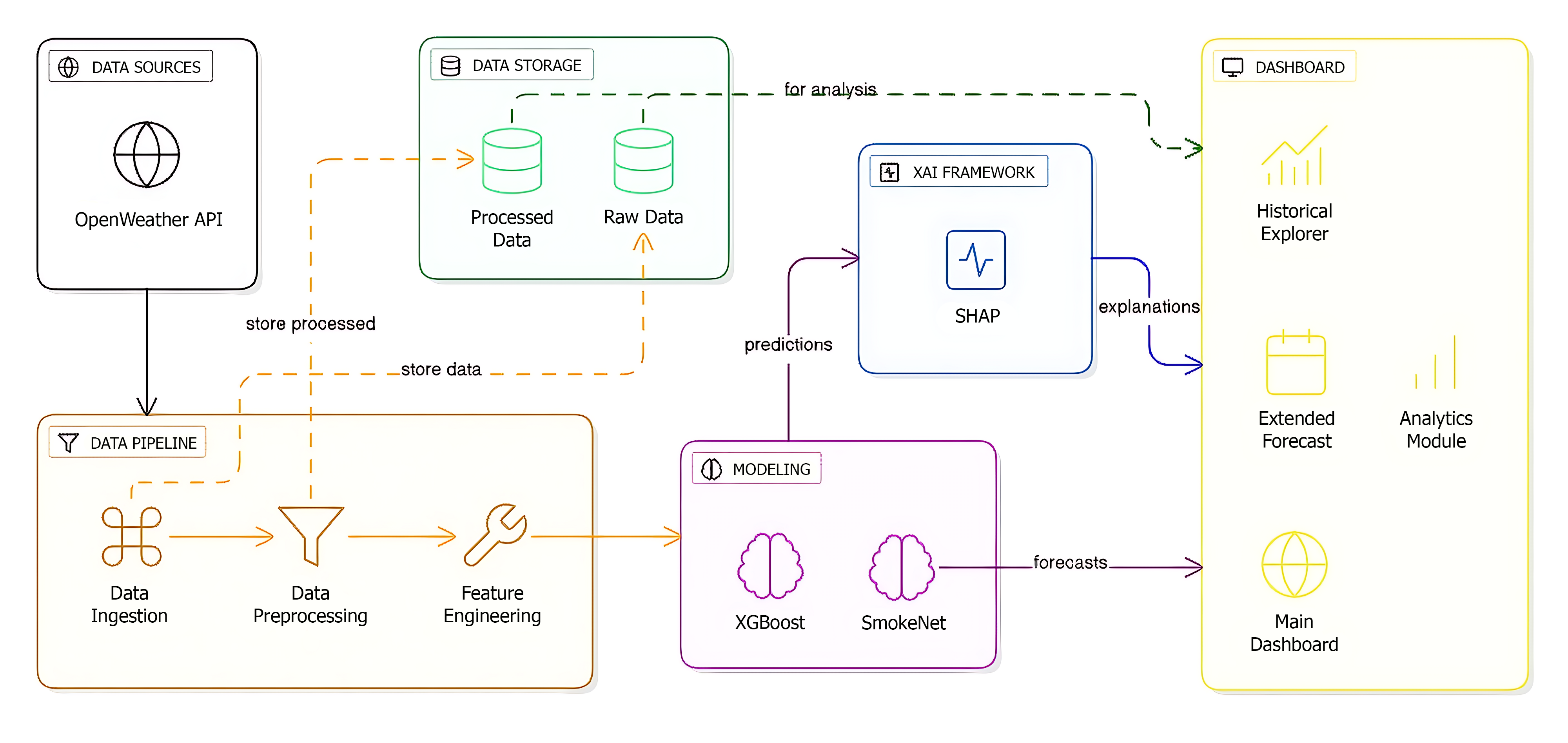
- Input history
- 48 h
- Mean PM₂.₅ forecast
- Next day
- Held-out test year
- 2024
Overview
SmokeNet is a transformer-based forecasting study using Melbourne air-quality data from the OpenWeather API. It uses 48 hours of history to predict next-day mean PM2.5, then connects forecasts to an interpretable alerting prototype.
Publication and evaluation
I am the first and corresponding author of the paper published at AJCAI 2025, Springer LNAI. The published chapter contains the numerical results and their experimental setup.
Training and validation precede a held-out 2024 test year. The May 2024 smoke-event backtest is a separate evaluation, not an extra independent test year. Metrics in the paper are reported on the original PM2.5 concentration scale after inverse transforms.
Architecture
- Custom transformer encoder with seasonal embeddings and a reconstruction loss that stabilises long-horizon error.
- Chronological cross-validation keeps training and evaluation ordered in time.
- Data from the OpenWeather Air Pollution API, spanning late 2020 to early 2025.
Explainability
Transparency is central to the project:
- Integrated SHAP, Integrated Gradients, and DiCE to audit forecasts both globally and per prediction.
- Used attribution and counterfactual analysis to inspect forecast drivers and possible changes to model inputs.
Product Surface
- Dashboard prototype for next-day PM2.5 forecasts and explanations.
- Proposed alert tiers mapped to the U.S. EPA AQI categories documented in the paper.
Lessons
- The model comparison depends on the data split and evaluation protocol. I report the held-out and smoke-event results separately.
- The original evaluation logs are not linked here. A consistency check on the paper's baseline table is pending; its numbers should not be treated as an independently reproduced benchmark.
- Attribution and counterfactual analysis help inspect a forecast. They do not establish that the system is ready for public-safety use.