CosmicOptic — exploring stellar light curves
A React/D3 frontend and FastAPI backend for a NASA Space Apps prototype, demonstrated with synthetic signals.
- My contribution
- Frontend + API
- Public demo inference
- Synthetic
- NASA Space Apps participation
- Oct 2025
The idea
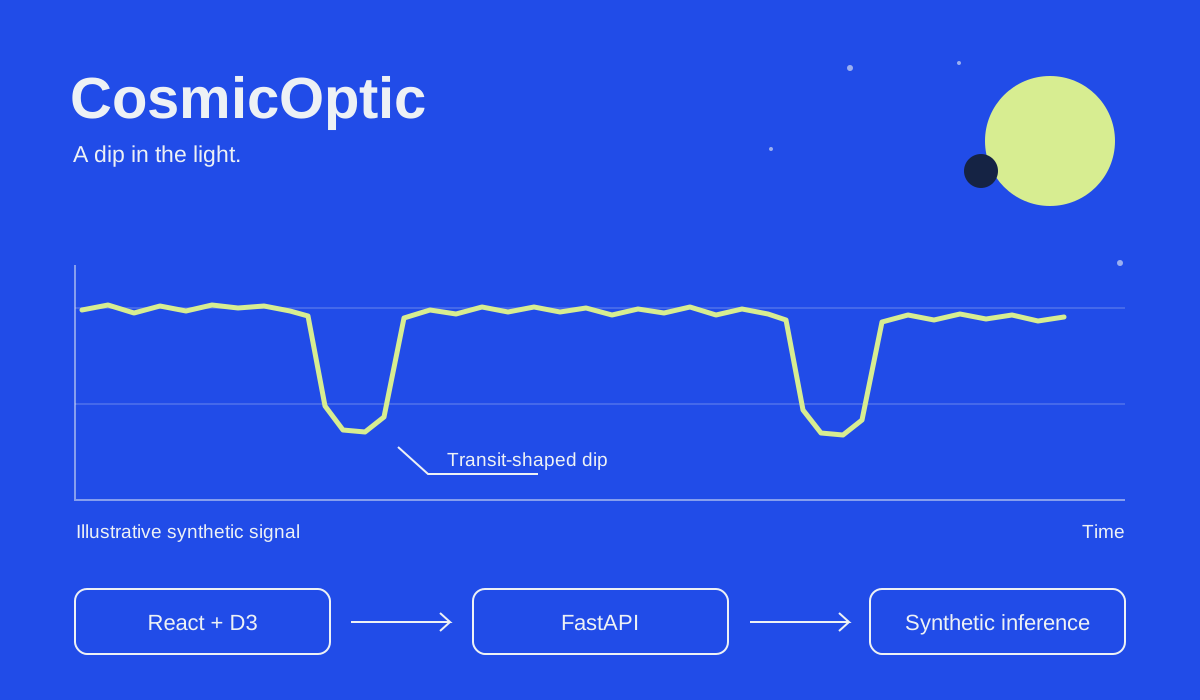
A possible planetary transit appears as a dip in a star's measured brightness. CosmicOptic gives that kind of signal an interface: select a light curve, inspect the curve and pass it through an analysis service.
The project was made for NASA International Space Apps Challenge 2025, held on 4–5 October. My role was frontend and backend development.
What I built
- A React frontend with interactive D3 light-curve views.
- A FastAPI backend and typed response models.
- A replaceable prediction-service interface connecting the UI to the analysis flow.
The cover illustration represents a synthetic transit-shaped signal. It is not an observed light curve or a model prediction.
What the public version does
The public prediction service currently calls a synthetic generator. The interface demonstrates how a result could be explored while keeping the inference component replaceable.
The SHAP-like visualization and confidence values in that version are also illustrative. The metrics endpoint returns fixed demonstration values, so those values are not an evaluation of a trained exoplanet detector.
Outcome and limits
We built a working frontend/API prototype for the hackathon. Integrating and evaluating a trained model remains outside the verified scope of the public web version.